
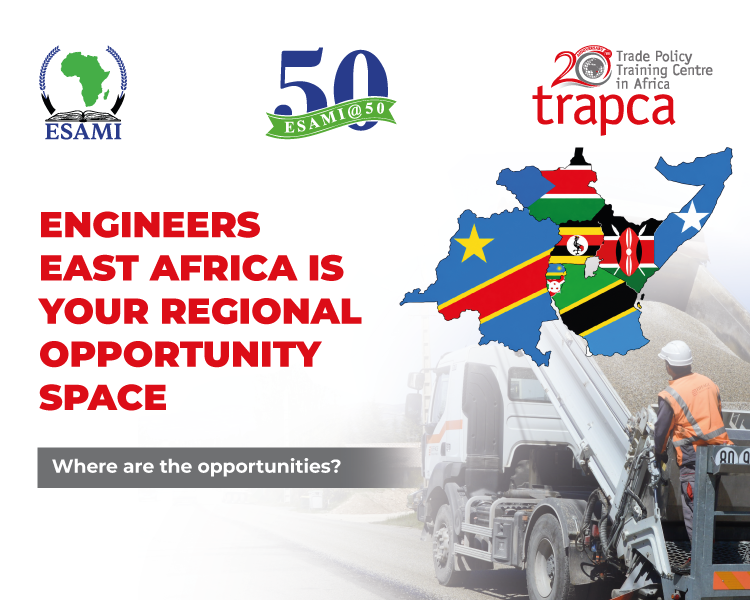
The East African Community Mutual Recognition Agreement on Engineering Services (EAC Engineering MRA) supports the mobility of eligible professional engineers across participating EAC Partner States. It provides a framework for engineers registered and in good standing in one participating country to seek professional recognition in another.
For engineers, this offers a pathway to a wider market for their skills, services and professional partnerships. Its scope extends across recognised engineering disciplines, subject to the registration categories and requirements of the competent national authorities.
Opportunities across engineering disciplines
East Africa’s infrastructure, industrial and economic development creates opportunities for engineers in a broad range of sectors, including:
- Civil, structural and construction engineering: roads, bridges, buildings, urban infrastructure and construction supervision.
- Electrical, energy and power engineering: generation, transmission, renewable energy, electrification and regional power interconnections.
- Mechanical, industrial and manufacturing engineering: machinery, production systems, fabrication, automation and plant maintenance.
- Chemical and process engineering: food processing, pharmaceuticals, fertilisers, cement, industrial gases and process safety.
- Electronics, telecommunications and digital infrastructure: broadband networks, data centres, control systems and smart technologies.
- Mining, petroleum and minerals engineering: extraction, mineral processing, pipelines, storage facilities and associated infrastructure.
- Agricultural and agro-processing engineering: mechanisation, irrigation, cold chains, storage and value-addition technologies.
- Water, environmental and climate engineering: water supply, sanitation, drainage, waste management, pollution control and climate adaptation.
- Marine, automotive and aviation engineering: ports, marine systems, vehicle technologies, electric mobility and technical aviation services.
- Biomedical and building services engineering: medical equipment, hospital systems, ventilation, fire protection, lifts and energy management.
Discipline names and classifications vary between countries. Eligibility for recognition is therefore determined by the relevant authorities.
A wider range of professional assignments
Regional engineering mobility extends beyond employment. Engineers can explore consultancy, feasibility studies, project preparation, design, supervision, contract management and technical advisory services.
Opportunities also arise throughout a project’s life cycle—from investment appraisal and technical due diligence to inspection, testing, operations, maintenance and asset management. This creates roles for engineers as specialists, advisers, project managers, technical reviewers and service providers.
Research, innovation, professional training and participation in public-sector or development-partner programmes offer further avenues for regional collaboration.
Opportunities for firms and entrepreneurs
For engineering consultants and entrepreneurs, regional recognition can support efforts to reach new clients, establish professional partnerships and contribute specialised expertise to cross-border assignments.
Engineering firms may benefit from collaboration with professionals in other participating countries, helping them assemble multidisciplinary teams and pursue a broader range of projects. These partnerships can also support knowledge exchange and strengthen local capacity to deliver complex assignments.
A single industrial facility, for example, may require civil, mechanical, electrical, chemical, environmental and automation expertise. Regional collaboration creates opportunities for these professionals to work together from design through to operation.
Why regional recognition matters
A wider professional market can help engineers build experience, develop networks and diversify their assignments. It can also improve access to specialised expertise needed for regional transport corridors, energy systems, manufacturing facilities, digital networks and climate-resilient infrastructure.
By facilitating professional recognition, the MRA supports greater participation in regional development and closer integration of engineering services within the EAC.
Preparing to pursue regional opportunities
Professional mobility begins with national registration. Engineers interested in regional practice should:
- Maintain professional registration and good standing in their home country.
- Keep qualifications, experience records and continuing professional development evidence current.
- Identify markets, projects and partnerships suited to their expertise.
- Understand the host country’s recognition and practice requirements.
- Familiarise themselves with the MRA application process.
Engineers who are not yet professionally registered should consult their national regulator or competent professional authority about the registration pathway.
The MRA facilitates recognition but does not automatically authorise practice or guarantee employment or contracts. Applicable host-country requirements—including practising licences, work permits, taxation, business registration and procurement rules—continue to apply.
Think beyond one discipline. Think beyond one employer. Think beyond one country. Think East Africa.
For further information, visit the EAC Engineering MRA Information Hub and the EAC Engineering MRA Digital Platform.