
The Engineering Mutual Recognition Agreement (MRA) is a regional framework within the East African Community designed to facilitate the recognition of engineering qualifications and professional competencies across EAC Partner States.
The MRA supports the movement of qualified engineering professionals across the region by providing a framework through which the professional qualifications and competencies of engineers can be recognised, subject to the applicable requirements and procedures of the destination Partner State.

The Engineering MRA is grounded in the EAC Common Market framework. Its legal and policy foundation includes the following instruments:
The Treaty for the Establishment of the East African Community provides the foundation for regional integration, including the establishment of a Common Market aimed at supporting the free movement of goods, labour, services and capital, as well as the right of establishment.
Useful link: EAC Secretariat
The EAC Common Market Protocol provides for the free movement of labour and services. Article 11 supports the mutual recognition of academic and professional qualifications, experience, licences and certifications granted in other Partner States.
Annex VII provides the broader framework for mutual recognition of academic and professional qualifications within the region. It supports harmonised standards, coordinated institutional mechanisms and transparent recognition procedures.
The Engineering MRA translates this regional commitment into a profession-specific pathway for engineering professionals.
East Africa is increasingly becoming an integrated market for professional services. Engineers are contributing to major regional projects and opportunities in infrastructure, transport, energy, construction, manufacturing, water, ICT and other sectors.
The MRA helps create greater clarity around the recognition of engineering professionals seeking to work across borders.
For engineers, this means greater awareness of pathways to professional recognition and mobility within the EAC.
The Engineering MRA provides a framework for cooperation and recognition among the relevant professional and regulatory authorities in participating EAC Partner States.
The Engineering MRA:
The Engineering MRA is currently treated as operational in the following participating EAC Partner States:
These arrangements allow professional engineers registered in one participating Partner State to seek recognition in another participating Partner State, subject to the host country’s registration, licensing and professional requirements. Campaign material notes that South Sudan has joined the Engineering MRA process, expanding the number of participating Partner States.
The wider EAC currently includes eight Partner States: Burundi, Democratic Republic of Congo, Kenya, Rwanda, Somalia, South Sudan, Uganda and the United Republic of Tanzania. For countries where the Engineering MRA implementation pathway is still being verified, the website should provide information cautiously and direct users to official national institutions.
Useful links:
It can help you take your career beyond your home country.
If you are a qualified and professionally registered engineer, the MRA can provide a pathway to explore professional opportunities in other EAC Partner States.
However, regional recognition does not mean automatic authorisation to practise. Engineers must comply with the applicable requirements of the Partner State where they intend to practise.
Your journey starts at home.
QUALIFY → REGISTER → SEEK RECOGNITION → MOBILISE → CONTRIBUTE
Professional registration with your national competent authority is an important first step.
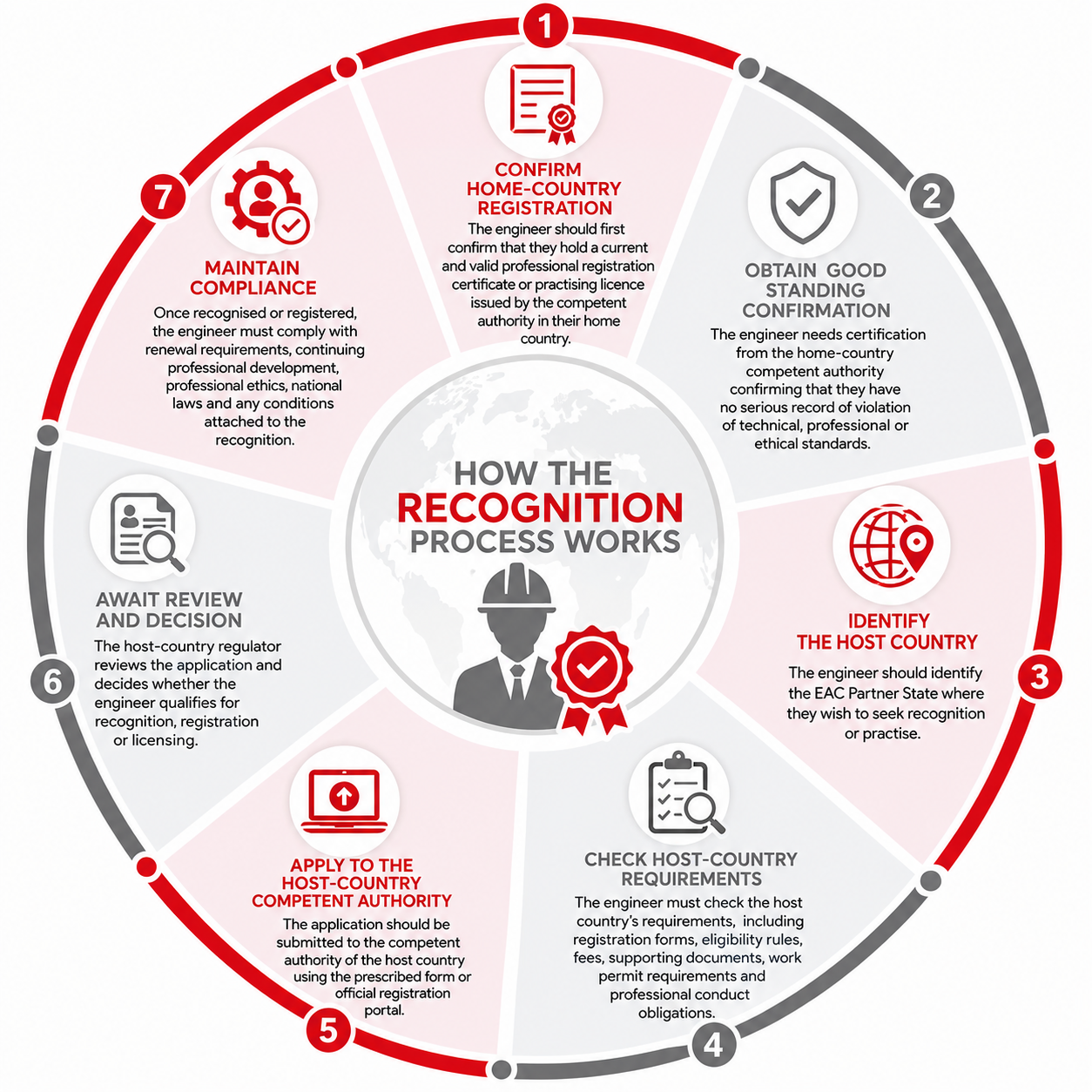
Under the Engineering MRA approach, an engineer seeking recognition in another participating Partner State should generally be able to show that they:
The application may also require a list of EAC Partner States where the applicant is already registered or licensed to practise, as well as a declaration on any past disciplinary action or professional sanctions.
The Engineering MRA works through national competent authorities. Engineers should always start with the official regulator in the country where they are registered and the country where they want to practise.
Kenya
Uganda
United Republic of Tanzania
Rwanda
South Sudan
Burundi
Democratic Republic of Congo
Somalia
For Burundi, DRC and Somalia, the website should clearly indicate that the Engineering MRA implementation pathway and competent authority arrangements should be verified before users rely on them for cross-border recognition.
The platform is developed for the EAC Secretariat, with financial support from GIZ-LIFTED – a project jointly co-financed by the German Federal Ministry for Economic Cooperation and Development (BMZ) and the European Union (EU) and technical support from ESAMI–trapca.